Monitoring Antiseizure Medications
Why We Check Medication Levels
For some antiseizure medications, we check blood levels to help guide treatment. We do this to:
- Make sure the medication is at a helpful level
- Avoid levels that are too low (may not control seizures) or too high (may cause side effects)
- Adjust doses when needed
- Check if medications are being taken as prescribed
Not all antiseizure medications require regular blood level monitoring. Your doctor will let you know which medications need checking and how often.
Understanding Medication Levels Throughout the Day
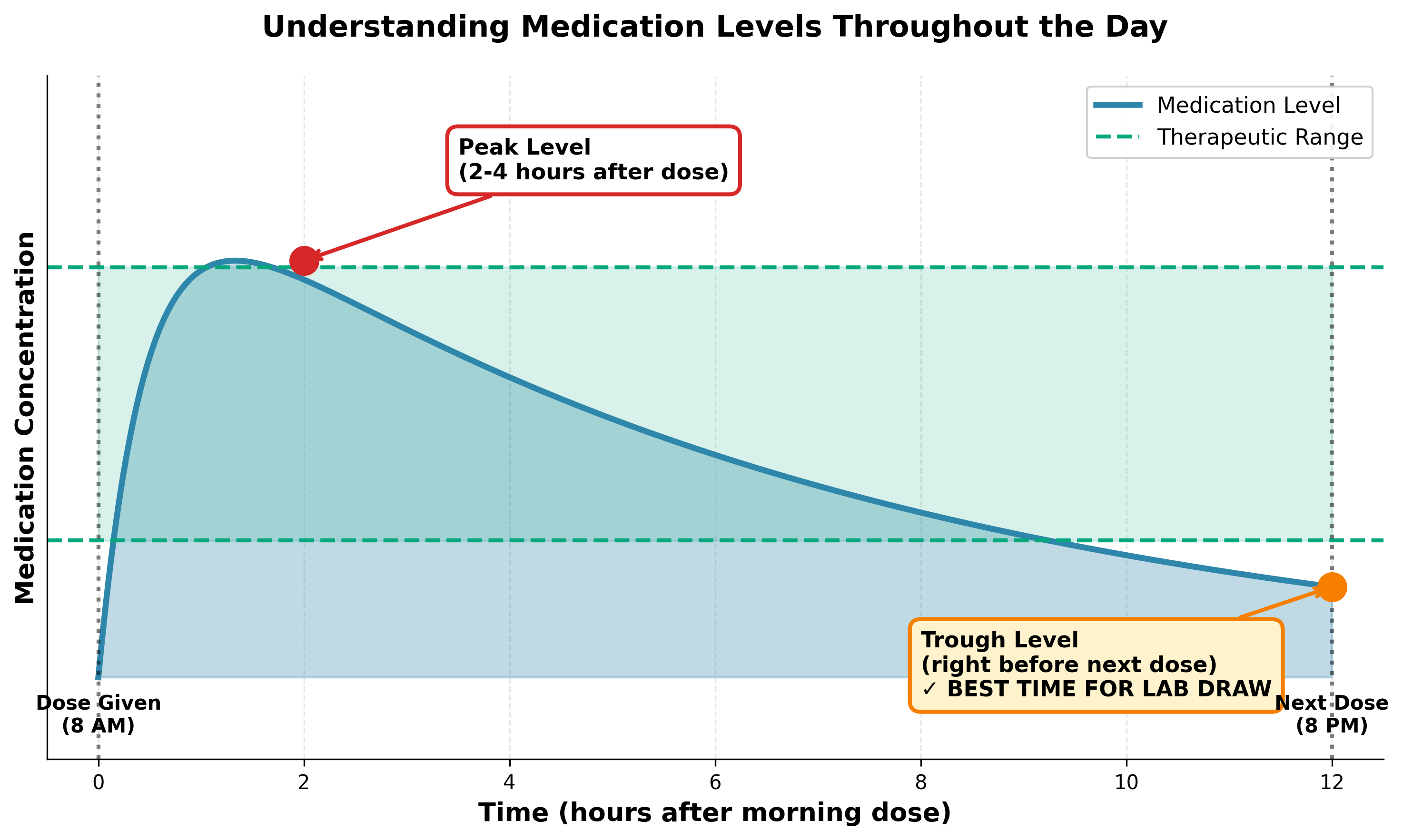
After you take a dose of medication, the level in your blood rises to a peak, then gradually falls to a trough right before the next dose. This happens every day with each dose you take.
Why Timing of the Blood Draw Matters
The timing of when we draw blood for medication levels is very important. Here’s why:
Trough Levels (Right Before Next Dose)
This is usually what we mean when we want to check medication levels for most antiseizure medications. We usually ask you to:
- Have blood drawn in the morning
- Take your medication AFTER the blood draw, not before
- Come in right before your usual morning dose time
Why trough levels are best:
- They represent the lowest level of medication in your system
- They are the most consistent and reproducible from day to day
- They reflect steady-state levels that predict your overall exposure to the medication
- We can compare them reliably to previous results
Peak Levels (2-4 Hours After Dose)
Peak levels represent the highest concentration of medication in your blood. We rarely check peak levels because:
- They vary more from day to day depending on food, absorption, and other factors
- They are harder to compare between visits
- For most medications, peak levels don’t predict seizure control or side effects as well as trough levels
What Do “High” or “Low” Levels Mean?
Many patients and families worry when they see results flagged as “high” or “low” on lab reports. Here’s what you need to know:
Therapeutic Range is a Guide, Not a Rule
The “therapeutic range” shown on lab reports is a general guideline based on averages from many patients. However:
- Some patients do best BELOW the range - They may have excellent seizure control with no side effects at “low” levels
- Some patients do best ABOVE the range - They may need “high” levels for seizure control and tolerate them well without side effects
- What matters most is how YOU are doing - Are seizures controlled? Are you having side effects?
A level flagged as “high” or “low” on a lab report does NOT automatically mean something is wrong. Your doctor looks at:
- How you are feeling
- Seizure control
- Any side effects
- The actual level number
- Previous levels for comparison
If your doctor needs to make a change, they will contact you. If you don’t hear from us, your levels are acceptable for you.
Common Reasons Levels Change
Your medication level can change for several reasons:
- Missed doses or taking doses at different times
- Generic medication changes - Different manufacturers may be absorbed slightly differently
- Other medications that interact with your seizure medication
- Weight changes - Especially in growing children
- Illness - Vomiting, diarrhea, or not eating normally
- Lab timing - Was blood drawn at a different time than usual?
Frequently Asked Questions
Q: My level came back “high” but I feel fine. Do I need to change my dose?
A: Not necessarily. If you’re doing well with good seizure control and no side effects, we may not change anything. Your doctor will discuss with you if a change is needed.
Q: Why doesn’t my child need blood draws for their medication?
A: Some medications have a wide therapeutic window and predictable dosing, so blood levels don’t usually help guide treatment. We can often adjust the dose based on seizure control and side effects instead.
Q: Should I take my medication before or after the blood draw?
A: In most cases, AFTER the blood draw. We want to check your trough level (lowest level right before the next dose).
Q: My level was “normal” but I’m still having seizures. Why?
A: Being in the “therapeutic range” doesn’t guarantee seizure control. You may need a higher dose, an additional medication, or a different treatment approach. Discuss with your doctor.
Q: How often will my levels be checked?
A: This depends on the medication and your situation. Initially, we may check more frequently. Once stable, we typically check every 3-6 months or when there’s a dose change, new symptoms, or other concerns.
Q: Can I eat breakfast before the blood draw?
A: Yes, eating is fine. Just don’t take your morning seizure medication until after the blood draw.
This information is for educational purposes only and does not replace medical advice. Always consult your healthcare provider about medications and treatment decisions.