3 Types of Seizures
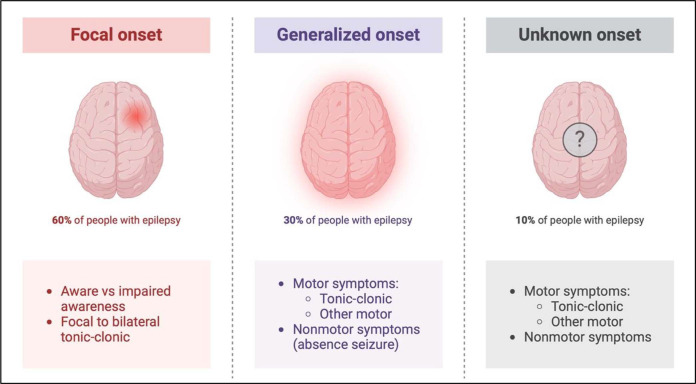
Seizures are classified primarily by where they start in the brain. This matters because the starting point shapes the seizure’s appearance, guides which tests are most useful, and influences which treatments are most likely to work. There are three broad categories: focal onset, generalized onset, and unknown onset.
3.1 Focal Onset Seizures
Focal onset seizures begin in networks limited to one hemisphere, meaning one side of the brain. They were previously called partial seizures. Within this category, seizures are further described based on whether awareness is preserved or affected.
In a focal aware seizure, the person remains conscious and can usually recall the episode afterward. Depending on which part of the brain is involved, they might experience jerking or tingling in one limb, an unusual smell or taste, a sudden surge of emotion like fear or déjà vu, visual disturbances, or a racing heart. These experiences can feel strange or frightening even though the person is fully aware of what is happening.
In a focal impaired awareness seizure, consciousness is partially affected. The person may stare blankly, appear confused, and perform repetitive automatic movements such as chewing, lip smacking, picking at clothing, or wandering. They typically cannot respond normally during the episode and will have little or no memory of it afterward.
A focal seizure can also spread from one hemisphere to both, producing a convulsion involving the whole body. This is called a focal to bilateral tonic-clonic seizure, because it begins on one side and evolves into a tonic-clonic seizure. Understanding that this type starts focally, rather than from both hemispheres simultaneously, is important because it affects how the epilepsy is classified and evaluated.
3.2 Generalized Onset Seizures
Generalized onset seizures involve both hemispheres of the brain from the very beginning. Because awareness depends on widespread brain network activity, most generalized seizures involve some degree of impaired consciousness.
3.2.1 Tonic-clonic seizures
Tonic-clonic seizures are the most widely recognized type. They unfold in two phases: first a tonic phase, in which the entire body stiffens and the person falls if they are standing, often with a cry as air is forced from the lungs. This is followed by a clonic phase of rhythmic, bilateral jerking of the arms and legs. The episode typically lasts one to three minutes and is followed by a period of confusion and deep fatigue known as the postictal period. Tongue biting and loss of bladder control can occur.
3.2.2 Absence seizures
Absence seizures look very different from convulsions. They are brief, usually just a few seconds, and consist of a sudden pause in activity, a blank stare, and sometimes subtle eye fluttering, followed by an equally abrupt return to normal. There is no falling, no convulsion, and no postictal confusion. Because they are so short and often so frequent, with some children having dozens or even hundreds per day, they are easily mistaken for daydreaming or inattention before the diagnosis is made. Absence seizures can be typical (abrupt onset and offset, characteristic on EEG) or atypical (longer, with a slower transition in and out).
3.2.3 Myoclonic seizures
Myoclonic seizures are sudden, brief muscle jerks, like an unexpected electric jolt, typically lasting less than a second. They most often affect the arms and shoulders and commonly occur in clusters shortly after waking in the morning. The person remains conscious throughout. Myoclonic seizures are a prominent feature of several epilepsy syndromes, including juvenile myoclonic epilepsy.
3.2.4 Tonic seizures
Tonic seizures cause a sudden bilateral stiffening of the muscles without a clonic phase. They are brief and most common during sleep. Because they cause falls, they carry a significant injury risk. Tonic seizures are most often seen in children with more severe generalized epilepsy syndromes.
3.2.5 Atonic seizures
Atonic seizures produce the opposite effect: a sudden loss of muscle tone that causes the person to collapse. Also called drop attacks, they are very brief but dangerous because of the falls they cause, often resulting in head injuries. Awareness returns quickly. Like tonic seizures, atonic seizures are most often seen in children with complex epilepsy syndromes.
3.2.6 Clonic seizures
Clonic seizures consist of bilateral rhythmic jerking without a preceding tonic stiffening phase. They are less common as an isolated seizure type and are more often seen as part of a broader seizure pattern.
3.3 Unknown Onset Seizures
Sometimes a seizure is not witnessed from the beginning, or the start is not captured on EEG or video. In these cases the onset is classified as unknown until further information, whether from another episode, from video recording, or from testing, allows for a clearer classification. This is a working category, not a permanent one.
3.4 Why Classification Matters
Getting the seizure type right matters for treatment. Some antiseizure medications work well for focal seizures but can actually worsen certain generalized epilepsies, particularly absence and myoclonic seizures. Starting with an accurate classification helps avoid this kind of mismatch and guides the neurologist toward the most appropriate medication or evaluation pathway from the outset.
Detailed descriptions of what a seizure looks like, from the very first sign to how long recovery takes, are genuinely useful to your neurologist. Video recorded on a phone, even if brief and imperfect, can be even more valuable. The chapter on getting diagnosed explains how these details guide the diagnosis.