17 Vagus Nerve Stimulation (VNS)
VNS does not cure epilepsy and will not completely eliminate seizures for most people. The goal is to reduce how often seizures happen, how long they last, and how hard the recovery is afterward. Most people continue taking seizure medications alongside VNS.
17.1 What is VNS?
Vagus nerve stimulation (VNS) is a treatment for drug-resistant epilepsy, meaning epilepsy that has not responded well to at least two appropriate seizure medications. Instead of acting directly on the brain, VNS works by sending regular, mild electrical pulses through the vagus nerve in the neck. The vagus nerve is one of the body’s main communication pathways between the brain and the rest of the body. Stimulating it can change neurotransmitter release, blood flow, and electrical rhythms in the brain in ways that make seizures less likely, although researchers do not fully understand every step of how this happens1,2.
VNS was the first FDA-approved device therapy for epilepsy. The FDA originally approved it in 1997 for adults and adolescents older than 12 years old with focal (partial) seizures that have not responded to medication. In 2017, the FDA broadened that approval to include children as young as 43. VNS is now one of the most widely used epilepsy devices in the world.
The FDA-labelled indication is still limited to focal seizures. That said, a 2013 practice guideline from the American Academy of Neurology found that VNS may also help seizures in children with generalized epilepsy, and specifically in Lennox-Gastaut syndrome, based on a smaller body of evidence than the focal seizure studies4. Your epilepsy team can tell you whether this applies to your child’s situation.
A key advantage of VNS is that it does not require knowing exactly where in the brain seizures start. This makes it an option for people who are not candidates for brain surgery, or for whom the seizure focus cannot be pinpointed.
17.2 How does it work?
A small device, roughly the size of a large coin, is surgically placed under the skin of the upper left chest. A thin wire runs from the device up through the neck, where a coiled electrode wraps around the left vagus nerve. The device is programmed to deliver regular pulses of electrical stimulation on a repeating schedule, typically cycling on for about 30 seconds every few minutes, continuously throughout the day and night. Most people are not aware of the stimulation once they get used to it.
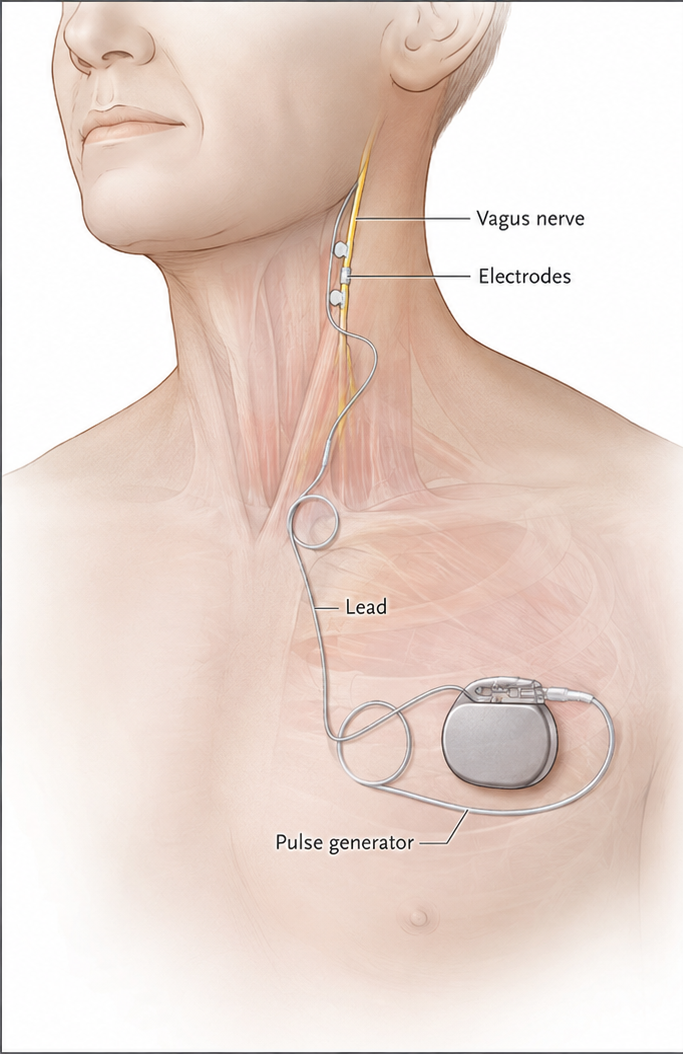
The newer generation of VNS devices includes a heart rate sensor. Because a rapid rise in heart rate often happens just before a seizure, the device can detect this change and automatically deliver an extra burst of stimulation, a feature called autostimulation, without any action needed from the patient or caregiver5,6.
17.2.1 The magnet
Patients and caregivers are given a small hand-held magnet. Swiping the magnet over the device triggers an immediate extra burst of stimulation, which can sometimes shorten or stop a seizure that is already beginning.
17.3 Understanding the settings
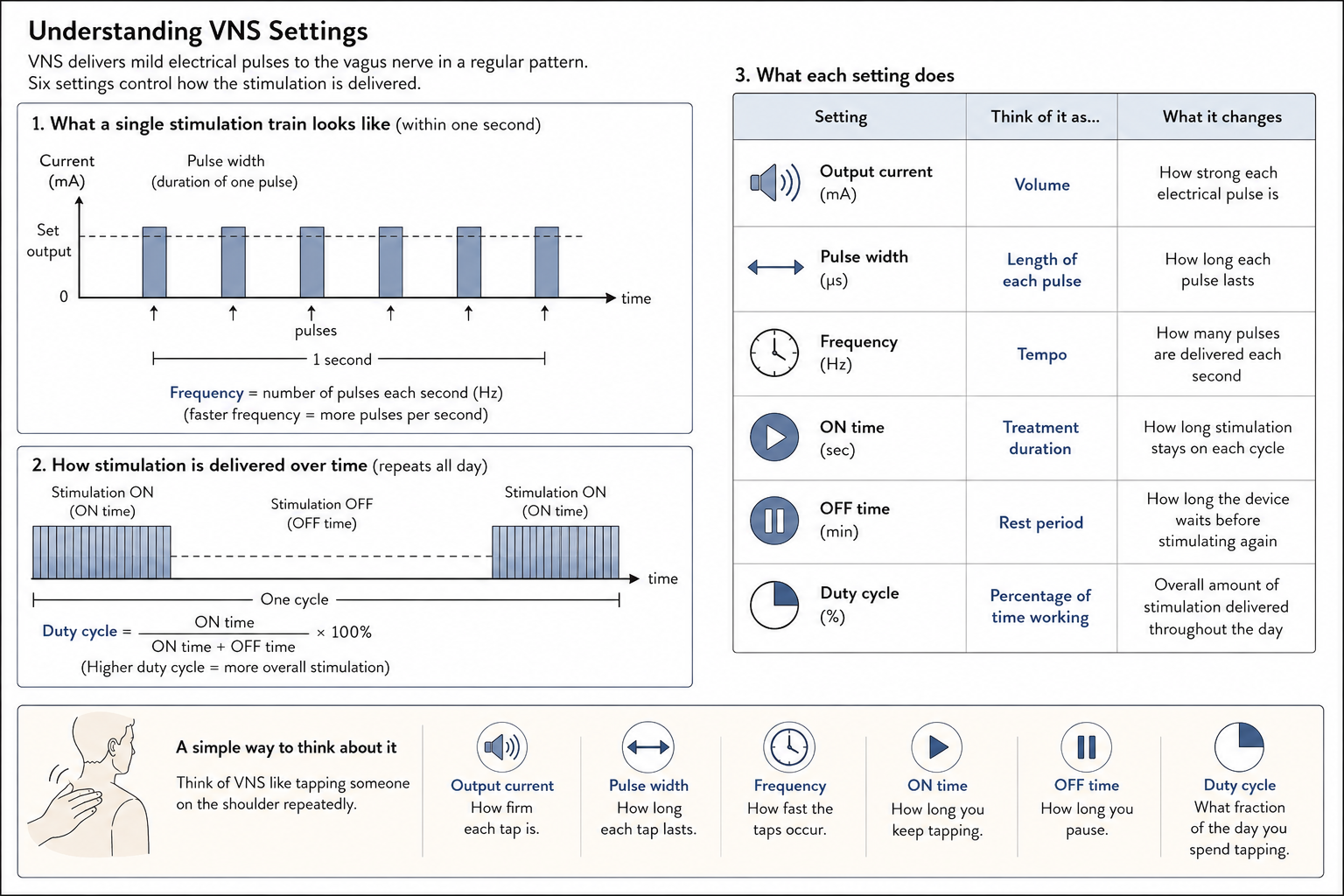
Your child’s epilepsy team controls VNS through six settings on the device. It can help to think of these the way you would think about the settings on a speaker system.
Output current is how strong each electrical pulse is, similar to volume. Pulse width is how long each pulse lasts. Frequency is how many pulses happen each second, similar to tempo. ON time is how long the stimulation runs during each active period, and OFF time is how long the device rests before the next one. Duty cycle describes the overall share of the day the device spends actively stimulating, and it is calculated from the ON and OFF times together.
None of these numbers needs to be memorized. What matters is knowing that your team adjusts them gradually and deliberately, aiming for a combination that controls seizures well while staying comfortable for your child.
17.4 Turning on VNS and titration
The device is not turned on to its full strength right away. On the day of activation, or shortly after surgery, your child’s team sets the output current very low, often around 0.25 mA (a unit of electrical current), so the body can get used to the sensation.
From there, the current is raised in small steps, typically by about 0.25 mA at a time, every few weeks. This slow, steady climb is called titration. The pace is deliberately unhurried because the most common side effects, a hoarse voice, a tickle in the throat, or mild shortness of breath during the stimulation itself, tend to fade as the body adjusts to each new level. Raising the current gradually gives that adjustment time to happen before the next increase.
Most children reach their first target dose within about two to three months of starting therapy7. Reaching that target is worthwhile even if it takes a few visits to get there, since research shows that people who stay undertreated for a long time can still benefit once they do reach an effective dose8.
Your child will have several follow-up visits in the first few months, usually in clinic, where the settings are checked and adjusted. Between visits, keep a simple record of any side effects and how they change over time. Side effects during stimulation almost always lessen as your child gets used to each new setting, but let the team know if something feels too uncomfortable to tolerate. There is no single “right” pace, and the team will slow down or pause increases if needed.
Once the initial target is reached, the team decides on any further adjustments based on how well seizures are controlled. If seizures are still frequent, the current may be increased further, or the rest period between stimulations may be shortened so the device spends a larger share of the day actively working. If seizures are already well controlled, the settings are often left where they are, since research suggests that pushing the dose higher once someone is already responding well does not reliably add much further benefit8,9. The team will still keep monitoring at follow-up visits and may fine-tune settings further if seizure control changes.
17.5 What results can be expected?
VNS rarely produces an immediate, dramatic change. Improvement tends to build gradually over months and years.
Early on, the effect can look modest: in the original blinded clinical trials, people saw about a 28 percent average reduction in seizure frequency during the initial three-month controlled study period10. The picture usually looks better with more time on therapy. In a large study of patients titrated to the current research-supported target dose, the median seizure reduction at 12 months was around 43 percent, with about half of patients reaching a 50 percent or greater reduction8. Benefits also tend to keep building over the following years. One major guideline review found that response rates continue to climb by roughly 7 percentage points from the first year of treatment out to five years4, and a large Norwegian population-based study similarly found the likelihood of a meaningful response kept increasing the longer someone stayed on therapy11.
Some people also notice improvements in mood, alertness, or overall quality of life that are separate from the effect on seizure frequency. A small number of people experience extended periods with very few or no seizures, but seizure freedom is not a typical outcome with VNS. If there is no meaningful benefit after an adequate trial, usually one to two years, the device can be turned off or removed.
17.6 Side effects
Side effects are usually related to the stimulation itself and tend to improve as the body adjusts or as settings are fine-tuned. The most common include a hoarse voice or change in voice during stimulation, which is the most frequently reported effect, along with coughing, throat clearing, mild throat discomfort, shortness of breath during exertion, and a tingling sensation in the neck.
These effects typically only occur during the stimulation phase, when the device is actively “on,” and often lessen over time. Most can be reduced by adjusting the stimulation settings.
Serious surgical complications are uncommon. Infection occurs in a small percentage of cases and may require antibiotics or, rarely, removal of the device. Damage to nearby blood vessels or the nerve that controls the vocal cords is rare.
17.7 Who is a good candidate?
VNS is most often considered for children and adults who have tried two or more appropriate seizure medications without achieving adequate control, who are not suitable candidates for resective (removal) surgery or prefer not to pursue it, whose seizure focus cannot be precisely identified, or who have epilepsy syndromes that affect widespread or both sides of the brain, such as Lennox-Gastaut syndrome.
VNS is generally not recommended for people with significant untreated obstructive sleep apnea, certain heart rhythm problems, or those with only one working vagus nerve.
17.8 Day-to-day life with VNS
Most people with a VNS device live normally. At airport security, carry the VNS identification card provided at implant; you can request a manual pat-down instead of walking through a scanner. Always tell any healthcare or dental provider about the device, since some medical equipment can interact with it. Everyday household magnets at normal distances are not a concern, but strong magnets, such as those in some headphones or in MRI machines, can temporarily affect the device. There are no special restrictions on sports or activities, though contact sports are worth discussing with your epilepsy team first.
Battery life is typically five to ten years depending on the settings used. When the battery runs low, a minor procedure replaces just the chest generator; the electrode wrapped around the vagus nerve does not need to be touched.
17.9 Key points
VNS is a long-term therapy. Benefits build slowly and continue to improve over months and years, and it works by stimulating the vagus nerve in the neck rather than operating directly on the brain. The most common side effect is temporary hoarseness during stimulation. A hand-held magnet can deliver extra stimulation at the start of a seizure. VNS does not replace medication but may allow a medication dose to be reduced over time if seizures improve. The device can always be adjusted, turned off, or removed if it is not helping.